


The tree-lined boulevards of Lutyens Bungalow Zone (LBZ) have observed India's evolution from colonial empire status to its current position as a worldwide economic power. Baroda House has been the most compelling witness to this change because it has maintained its original structure through time. In 2026, it will be a symbol of the pinnacle of strategic real estate in a city where land is literally the currency that matters most. For stakeholders in the Indian real estate industry, Baroda House is a masterclass in how history and location combine to make a building truly irreplaceable.
The Blueprint of a Royal Legacy
The story of Baroda House begins not in a meeting room in Delhi but on a train from Bombay in 1921. Here, Sir Edwin Lutyens, the architect whose name is now synonymous with India’s capital city elite, allegedly designed the first blueprint for the Delhi residence that would house Maharaja Sayajirao Gaekwad III. The Gaekwads ruled the Princely State of Baroda while embracing progressive lifestyle choices and cultivating their love for exquisite things.
The building, constructed between 1928 and 1936, stands as an authentic representation of the Indo-Saracenic architectural style. Lutyens created a building design that followed European architectural rules through its symmetrical layout, while he integrated Indian elements such as the central dome that resembles the Great Stupa at Sanchi. According to present-day property investors, the building's design demonstrates the architect's extensive understanding of land development techniques and weather patterns. The semi-circular arches and cooling arcades, far from being merely aesthetic features, were functional necessities that created a temperate microclimate conducive to an environment, well before the invention of modern air conditioning.
Strategic Location: The Heart of the LBZ
In the context of the 2026 real estate scenario, the word "location" is an understatement when referring to Baroda House. Situated on Kasturba Gandhi Marg, the property enjoys a high-security, low-density location that remains the most prized postal code in the country. In terms of sheer land size, estimated at between 8 and 12 acres, the property belongs to the bracket where land values run into thousands of crores.
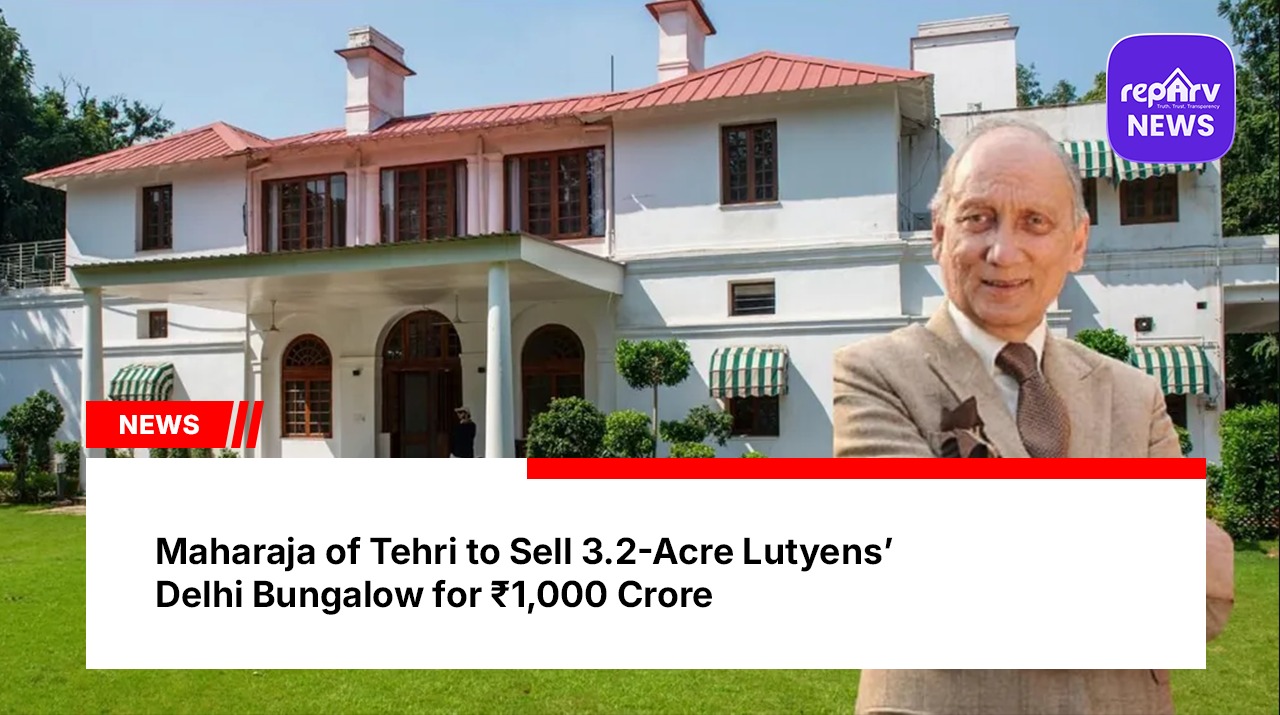
While the bungalows around the LBZ have attracted marquee deals that go from ₹500 crore to over ₹1,000 crore, the reality for Baroda House is that it operates on a different plane. It's a Grade I heritage building, meaning that the exterior must be preserved at all costs. This, while restrictive for any commercial development, makes the building's "prestige value" grow exponentially. In a city that's been flooded with glass and steel structures, the scarcity of heritage land makes Baroda House the cornerstone of Delhi's identity.
Adaptive Reuse and the Northern Railway Era
Post the merger of the princely states with the Indian Union, the building's use shifted from a royal abode to a significant administrative centre. Today, the building functions as the zonal headquarters for the Northern Railway. Experts say this represents the essence of adaptive reuse. Instead of succumbing to colonial-era neglect, the building has been economically and administratively active for over seven decades.
Walking through the corridors of the building today, one can witness the juxtaposition of the 19th-century royal opulence and the buzzing machinery of India’s transport backbone. The narrow-gauge MTR class steam locomotive remains stationed on the plush front lawns, remaining a permanent reminder of its current inhabitants. Nevertheless, the current occupation has also had its share of complexities. Through various legal forums, the Gaekwad family has claimed a degree of proprietorship over the building through the 1949 Instrument of Accession.
Market Implications for 2026 and Beyond
As the Land and Development Office (L&DO) seeks to simplify the process of conversion of leasehold properties into freehold properties, the spotlight has never shone brighter on Lutyens’ Delhi. The government introduced new policies linking conversion charge payments with circle rates, which led to the resolution of more than ₹1,100 crore in frozen transactions throughout the region. Baroda House has served as a reminder that the most valuable real estate is one that has a strong foundation of history and clarity.
For the modern investor or real estate aficionado, Baroda House provides valuable lessons for the contemporary era. First, the importance of heritage as a multiplier for real estate. Second, the only hedge against market volatility is "strategic location." And third, the secret to successful real estate lies in its ability to change and transform over time, from a palace for a maharaja to a headquarters for a railroad company, without sacrificing its architectural integrity.
As Delhi expands outward towards the NCR periphery, the "Golden Acre" of Baroda House remains a reminder of an era in which real estate was built to last for centuries, rather than just the fiscal quarter. It remains a crown jewel in the Lutyens map of Delhi, where every stone bears witness to the ambitions of royal patrons and every acre represents the very pinnacle of Indian land values.




.webp)
.webp)
.webp)

.webp)


.webp)
.webp)
.webp)
.webp)











.webp)
.webp)


.webp)
.webp)
.webp)
.webp)
.webp)
.webp)
.webp)
.webp)






























.jpeg)