

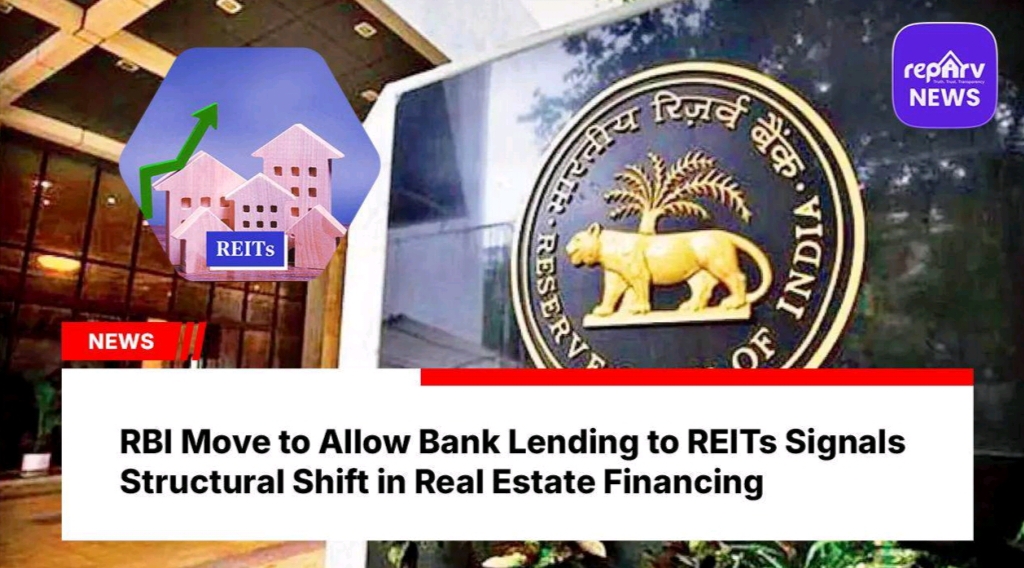
The move by the Reserve Bank of India to consider letting banks extend direct credit to Real Estate Investment Trusts represents an important step that may change the funding paradigm in the next big area of commercial real estate in the country. This move has been done as a part of RBI's recently formulated monetary policy framework.
Until now, banks in India have tended to remain on the sidelines when it comes to lending to the REITs asset class. While the option of raising funds through the equity market, bonds, and other structured products has indeed been there, direct bank lending options have fallen into a regulatory grey area. This in many cases has led to increased borrowing costs for REITs, which then have to settle for borrowing funds from other financial institutions or capital markets, which generally are costlier and less manageable.
Secondly, as the RBI opens up funding through banks, subject to their prudence, it looks as if they are acknowledging the growing maturity level across the Indian REITs sector. This is because, over a short period, since the issuing of regulations pertaining to REITs in 2014, the Indian REITs sector has enjoyed a smooth growth curve, primarily owing to a constant feed of high-grade commercial properties being rented out on long leases and generating a robust return through rentals. Specifically, office-based REITs have continued to attract higher investor interest, both on an overall basis, especially including retail, as well as institutional investors, owing to a growing corporate presence and a need for Grade A office space.
The commercial real estate space is in a process of recalibration after the pandemic. Office space demand is high in main cities. However, refinancing is a point of concern for developers and owners in a challenging funding environment characterized by high rates and poor liquidity. A new funding option for REITs might be a welcome relief in providing a more stable and lower-cost funding alternative when refinancing of debt and funding of asset purchases are indispensable.
For industry experts, this was a logical step ahead in the Indian financial landscape. REITs are highly regulated entities that have to distribute a large component of their cash flows and also adhere to strict leveraging and valuation of their real estate assets. This helps the REITs present a lower credit risk profile as compared to other real estate developers who may be prone to a variable income pattern and are project-centric. This makes REITs a relatively safer borrower from a bank's perspective, subject to proper risk-weight criteria.
Systemically, the RBI's caution in its approach is reflected. The proposal is likely to be accompanied by measures to guard against the systemic risk of large bank financing of assets linked to the real estate sector. The regulatory guidance on loan-to-value ratio, exposure limits, or treatments of loans to REITs under capital adequacy norms will be very crucial in shaping bank involvement in this area.
It has been perceived in the market that the reduced funding costs will also have a direct positive impact on investors. Lower interest expenses can also favorably impact the dividend yields of the unit holders of the REIT. This can therefore bolster the case of investing in the asset class of the REIT, as investors are increasingly searching for return opportunities, especially in a volatile market.
This move could also pave the way for bringing the REIT industry in India in line with international standards. Bank finance, as a component, is a feature in the REIT models of mature markets like the US, Singapore, and Europe. Access to bank finance has enabled REITs in these countries to efficiently manage leverage and optimize capital costs to achieve economies of scale. This new regulatory guideline indicates a perceptible trend towards standardization of international norms.
However, all will depend on the banks' feedback, and while permission might be required, it is the actual loans that may be extended by a bank after possibly going through its specific risk assessment and limits, if any, on sectors and overall credit appetite of banks. Banks are likely to adopt a conservative stance and extend loans largely to big and well-established REITs having diversified assets and strong sponsor support.
The proposal may have indirect implications for the broader real estate sector. Liquidity conditions for REITs would improve, which would encourage developers to monetize their assets to the greatest extent possible. This would thus ease the recycling of funds for new projects, contributing to new supply within the commercial segment and job creation within the construction segment.
Equally intriguing is the timing of RBI's consideration. In an era when infrastructure development and urban expansion, along with foreign investment, have stolen the spotlight in India’s economic growth story, the urgent need for enhancing institutionalized real estate platforms has gained equal prominence. This has been addressed by REITs, for sure, as they promote the twin mantras of greater transparency and governance. Increasing their access to formal credit channels could reinforce investor confidence and market depth.
However, analysts sound a word of caution against the move being the immediate trigger for aggressive expansion. Consultation on regulations, final guidelines, and bank-level implementation would take some time. Moreover, calibration of any such relaxation would be subtle rather than sweeping given the nuancing of the central bank on the importance of financial stability.
In the months ahead, the structuring of the final framework by the RBI and, thereby, the lending portfolio inclusion by the banks is the focus. If the policy is implemented prudently, we may perhaps see a big shift or tipping point in the financing of the commercial real estate sector in the country towards more institutional, transparent, and robust models of finance.
For the time being, this is a measure to express intent—an acknowledgment of the country's monetary authority that REITs have turned out to be an earnest instrument that deserves greater economic integration.






.webp)

.webp)
.webp)


.webp)




.webp)
.webp)
.webp)
.webp)

















.webp)
.webp)


.webp)

.webp)
.webp)
.webp)
.webp)
.webp)
.webp)
.webp)





































.jpeg)