

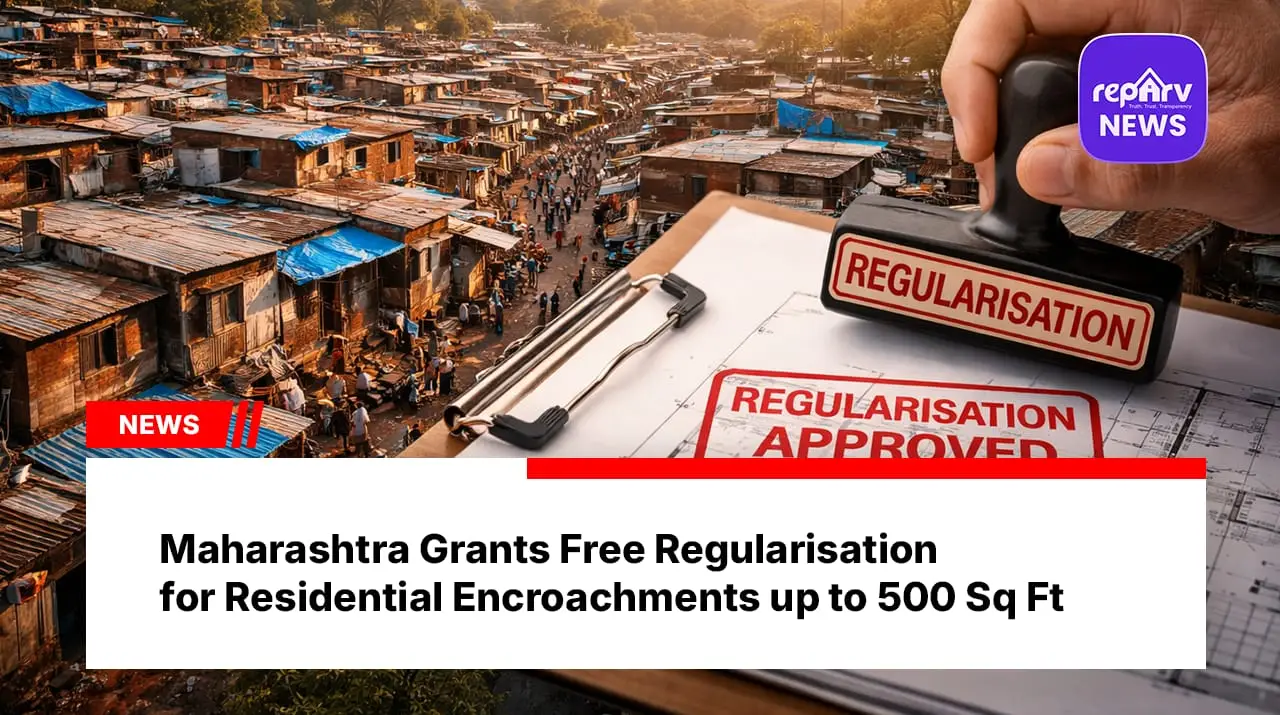
In a major policy change, the Maharashtra government, in its effort to provide housing security to the poor living in urban and rural areas, has officially sanctioned the free regularisation of residential encroachments up to 500 square feet. The decision, outlined in a government resolution issued on Friday, is expected to benefit hundreds of thousands of poor families living in the state for the last decade or more.
A Major Policy Shift for Housing Stability
The decision, taken under the leadership of Chief Minister Devendra Fadnavis and Revenue Minister Chandrashekhar Bawankule, will allow the regularisation of all residential structures located on government land that were constructed before the cutoff date of January 1, 2011. While the regularisation of residential encroachments up to 500 square feet will be free of cost, the policy also allow the regularisation of larger areas. For residential encroachments ranging between 500 and 1,500 square feet, the government will allow the regularisation of the land, subject to payment of 10% of the current market value as an occupancy fee.
Revenue Minister Bawankule has also stated, "This is a cornerstone of the 'Housing for All' initiative and also a part of the 'Viksit Maharashtra 2047' vision." "The government's firm stance is that no needy family in the state should remain without shelter," the Minister has also asserted, while stating that the progress of the scheme will be reviewed every three months for efficient execution.
Geographic Coverage and Key Exclusions
One key feature of this policy is its applicability across all areas of Maharashtra, with the only exceptions being Mumbai City and Mumbai Suburban districts, where SRA and cluster redevelopment schemes are already in place.
However, the government has laid down strict guidelines regarding areas of environmental and public safety concerns. Encroachments on ecologically sensitive areas, including river beds, canal areas, gairan lands, public roads, forest areas, crematorium areas, school lands, and hospital lands, will not be regularised, and their demolition is likely. However, on humanitarian concerns, the government has assured that all affected families will be provided shelter under the Pradhan Mantri Awas Yojana Scheme.
Verification and Implementation Framework
The government has mandated a verification process to prevent misuse. Applicants must provide proof of residence before January 1, 2011, such as voter ID records, electricity bills, or property tax receipts. In addition, proof of residence for the past year will also be mandatory.
The land will be classified as ‘Occupant Class-2,’ and ownership will be registered jointly in the names of the husband and wife. In cases where the structure is partially commercial, the government will charge 25% of the market value for the commercial portion.
Implementation will be carried out through the formation of special committees at different administrative levels. District Collector, Sub-Divisional Officers, and Tehsildars will be the heads of these committees. In addition, implementation will be monitored by a 17-member committee headed by the District Guardian Minister. Local MLAs will head the committees formed for each constituency.
The policy also includes a strict security provision: regularisation is limited to Indian citizens only. Authorities have also been instructed to ascertain the applicant’s nationality and to file police complaints, and initiate demolition of structures owned by non-citizens immediately.






.webp)
.webp)
.webp)

.webp)



.webp)
.webp)
.webp)
.webp)










.webp)
.webp)


.webp)
.webp)
.webp)
.webp)
.webp)
.webp)
.webp)
.webp)



























.jpeg)