

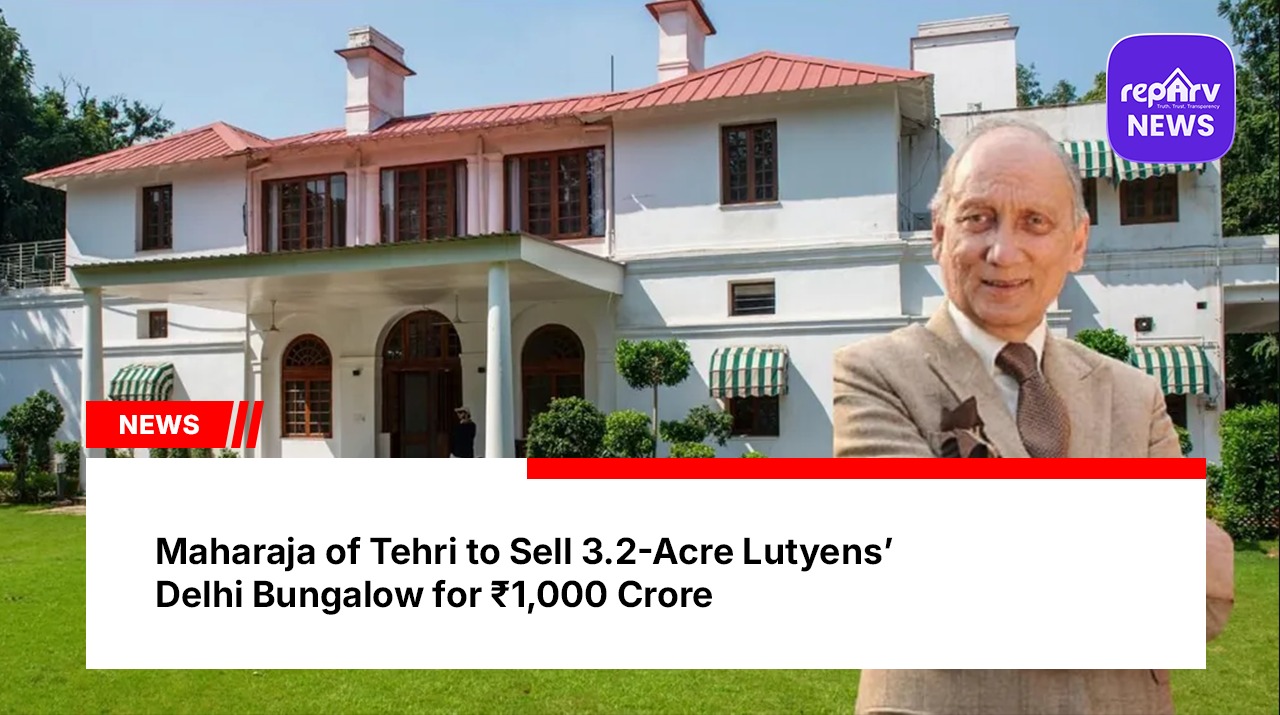
In one of the most value-accretive luxury property deals to have taken place in the national capital in recent times, Maharaja Manujendra Shah of Tehri Garhwal is set to sell his sprawling 3.2-acre bungalow on Bhagwan Das Road in the prestigious Lutyens' Bungalow Zone for an estimated ₹1,000 crore. The deal, currently at an advanced stage, is expected to rank among the highest-value private residential property transactions ever recorded in New Delhi.
Spread over approximately 12,950 square metres in the heart of the capital, the mansion is located within one of India's most highly protected and elite enclaves: the Lutyens' Bungalow Zone. The LBZ, designed by British architect Edwin Lutyens as part of his early 20th-century plan for New Delhi, represents power, heritage, and a limited scope of elite ownership. Properties in this zone rarely come up for sale due to very limited private ownership and very strict norms for redevelopment.
According to credible media reports, the buyer is a major entrepreneur with sizeable food and beverage businesses. The identity of the buyer has not been disclosed, but sources close to the deal say that the family already owns real estate in Lutyens' Delhi and is consolidating its presence through several high-value acquisitions in the area. A public notice appears to have been given by a leading law firm on behalf of the buyer to bring to notice any claims or objections against the title of the property on Bhagwan Das Road—it is a standard due diligence exercise in relation to such large deals.
The amount of ₹1,000 crore indicates that demand for ultra-prime residential land in central New Delhi remains strong and enduring, despite the ups and downs that occur in the field. The LBZ is unlike any other residential market. It is an end-user-driven market in a rarefied ecosystem influenced by legacy ownership, proximity to political power, architectural heritage and acute scarcity of supply. Of the nearly 3,000 bungalows in the zone, only a small fraction is privately held. With such low levels of private ownership, transactions are a rare occurrence, often after long negotiations, legal vetting and regulatory clearances.
The Maharaja of Tehri's estate is a trophy asset not just because of its land size but also for the fact that it falls within the zone generally known for diplomats, senior government officials, industrialists and prominent families. Market observers say parcels of land over three acres within the LBZ is rare in themselves, adding greater significance to the proposed transaction.
Furthermore, adding to the quantum of the buyer’s real estate purchase, reports have revealed that the same entrepreneur is in the process of buying another landmark property in Lutyens Delhi. The building in question is the former official residence of India’s first Prime Minister, Mr. Jawaharlal Nehru, on Motilal Nehru Road. The independent acquisition has been valued at in excess of ₹1,100 crore. Combined, the two acquisitions at the reported values would aggregate to ₹2,100 crore, thereby representing the largest acquisition of luxury residential properties.
Industry experts have commented that these deals reflect a broader global phenomenon in which UHNWIs perceive prime land holdings as reservoirs for long-term wealth preservation. Lutyens’ Delhi has similar characteristics wherein it operates as a reservoir for wealth preservation relative to various locations globally, such as London, New York, or even Hong Kong, wherein properties, or rather, land holdings within legacy areas, act as stores for wealth that remain uninfluenced by any shorter-term macro-economic fluctuations.
The potential sale also points to the shift in asset management strategies by erstwhile royal classes and legacy landowners. While many are maintaining legacy estates, others are seeking to monetise some of their best properties because of rising land prices and improving liquidity in India’s high-net-worth segment. As capital markets create new billionaires and entrepreneurial wealth creation grows across all sectors, the fight for the best locations within the capital has certainly increased.
Real estate consultants suggest that the transactions of ultra-luxury plots are done in a rather secretive manner and are carried out with the intention of meeting the regulatory requirements with regard to the LBZ. The development regulations in the zone are rather strict, and subdivisions and reconstruction are not easily allowed. These plots are therefore purchased by investors mainly for residential purposes.
The wider property market could see little effect from the deal, at least in terms of mainstream housing costs within Delhi NCR. However, the acquisition cements Delhi’s reputation as one of the most costly residential markets in all of Asia at the high end of the scale. It may also indicate the faith of India’s richest investors in the long-term security of land holdings in politically or historically sensitive areas.
As the deal moves closer to finalisation and due registration, focus will continue to be maintained on how the reported valuation of ₹1,000 crore is confirmed during closing. If the deal is successfully closed at the reported valuation, it will mark a milestone occasion in the history of luxury realty in the capital city, reaffirming its Lutyens’ Delhi address as the prime residential address in India.






.webp)
.webp)
.webp)

.webp)



.webp)
.webp)
.webp)
.webp)












.webp)
.webp)


.webp)
.webp)
.webp)
.webp)
.webp)
.webp)
.webp)
.webp)































.jpeg)