

Navigating a Period of Institutional Recalibration
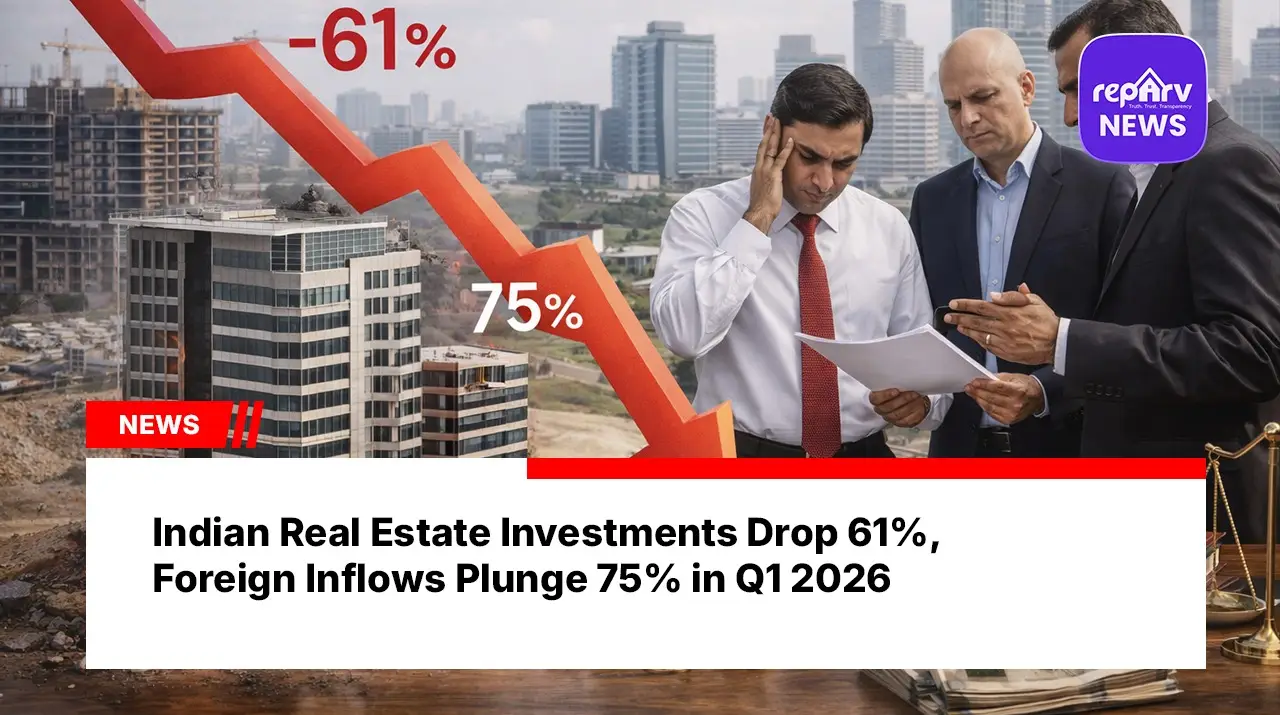
The Indian real estate market is currently undergoing a major shift in its investment structure. The Colliers Q1 2026 report shows that institutional investments in the Indian real estate market experienced a 61% decrease, from 4.2 billion dollars in late 2025 to 1.6 billion dollars in the first quarter of 2026. The initial results may cause concern, but market experts view this as a temporary development that will eventually restore interest in the real estate market. The real estate market is currently experiencing two simultaneous trends: high base effects from the previous quarter and adjustments to global economic conditions.
The Impact of Global Uncertainty on Foreign Inflows
The most significant finding from the latest research shows that foreign investments fell 75%, declining to 400 million dollars. The current geopolitical situation in West Asia has caused financial markets around the world to respond with defensive strategies. This has led global investors, including sovereign wealth funds and private equity firms, to adopt a ‘wait and watch’ approach as they assess the impact of ongoing conflicts on trade routes, crude oil prices, and overall commodities stability. Badal Yagnik, CEO of Colliers India, however, states that this phase will pass. In the long term, the potential of India’s consumption-driven economy will continue to attract investors in the Asia-Pacific region.
Domestic Investors as the New Market Stabilizer
The retreat of global investors has led to the emergence of domestic investors as the new market stabilizers. In the first quarter of 2026, local capital accounted for almost three-fourths of the total institutional inflows, amounting to a substantial 1.2 billion dollars. This growth in local investors is a reflection of the maturity of the Indian real estate market. Domestic institutional investors, such as Alternate Investment Funds (AIFs) and insurance companies, are clearly demonstrating a deep-rooted faith in the internal growth story of the country. Their participation is thus providing a crucial safety net, so that the growth trajectory in major metropolitan cities does not lose steam even in a scenario of shrinking global liquidity. This phenomenon thus marks a broader shift wherein the ‘India-for-India’ investment theory is turning into reality.
Analyzing the Shift in Asset Class Preferences
The allocation pattern of funds among various types of properties has also witnessed a notable shift. Although commercial properties remain the preferred destination for institutional investors, office segment investment fell sharply from over 3 billion dollars in the previous quarter to approximately 821.1 million dollars in Q1. This decline may be attributed to the timing of major transactions, combined with global trends in industrial space utilization. Nevertheless, the demand for Global Capability Centres (GCCs) has helped maintain a base for the office segment. At the same time, other segments like the industrial and warehousing sectors are gaining momentum, with the diversification of the supply chain continuing to be a top priority for corporations. This sector is witnessing a trend towards a more diversified investment portfolio where stability is sought through various specialized investment classes.
A Transitional Phase Rooted in Long-Term Optimism
The current investment scenario can be best defined as a "transient pause." Although Q1 2026 numbers reflect the immediate impact of global volatility, structural changes in the real estate sector over the past few years, such as the strengthening of REITs and improved regulatory transparency, have provided a solid foundation for a rebound. Industry experts have indicated that with the stabilization of the geopolitical scenario and the regularity with which interest rate cycles operate, foreign capital is likely to flow back to the Indian market in a major way. Until then, the involvement of domestic capital ensures that the sector continues to remain buoyant.
Conclusion: Looking Toward a Resilient Future
The 75% drop in foreign investment serves as an attention-grabbing news story, but the Indian real estate markets continue to demonstrate resilience. The emergence of domestic investors as a dominant market force established a protective barrier that did not exist during the prior economic period. The Colliers report shows that the slowdown in the real estate market is merely a cyclical response to external influences, and the market is poised for a revival as global sentiment improves. In fact, the "cushion" effect of the local investor is not merely a short-term measure but an indicator of a more self-sufficient and mature investment culture in India.






.webp)

.webp)
.webp)


.webp)


.webp)
.webp)
.webp)
.webp)

















.webp)
.webp)


.webp)

.webp)
.webp)
.webp)
.webp)
.webp)
.webp)
.webp)
































.jpeg)