

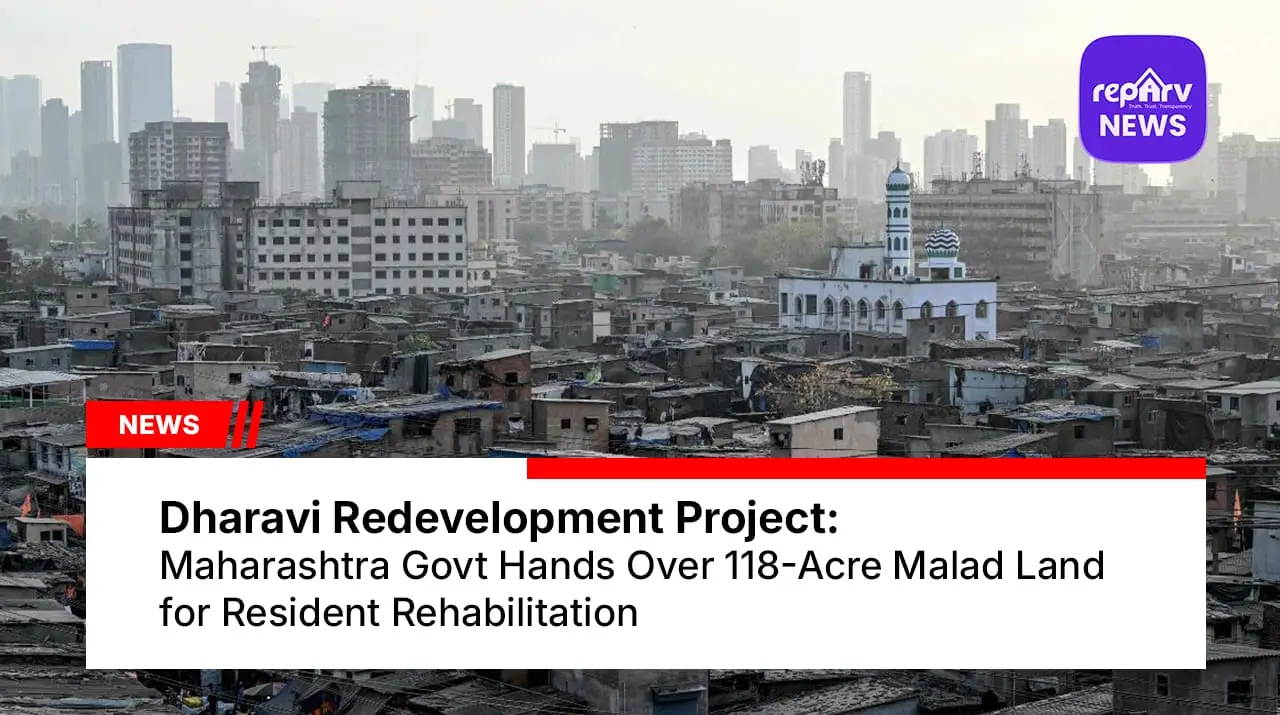
The Mumbai real estate market is undergoing a paradigm shift as the Maharashtra Government has finally transferred a whopping 118-acre land parcel in Malad-Malvani to the Slum Rehabilitation Authority (SRA) for the Dharavi Redevelopment Project (DRP). This significant development, which came to light in February 2026, marks a major turning point in the implementation of what has been recognised as the world's largest urban renewal project. With the acquisition of this prime land at Mukteshwar, the Maharashtra Government has finally found a lasting answer to the non-in-situ rehabilitation of thousands of residents, thereby mitigating one of the most challenging logistical aspects of this massive project that has been in the pipeline for several decades.
From the perspective of infrastructure and real estate news, this is a masterstroke move in the management of land resources. The 118-acre land is part of a larger 140-acre earmarked plot, with the remaining 22 acres being held in legal disputes. For the Adani Group, which heads the Special Purpose Vehicle (SPV) called Navbharat Mega Developers Private Limited (NMDPL), this is a crucial transfer that will give them the necessary canvas to start constructing on a large scale for the residents who do not fall under the free housing category in the Dharavi region.
Financial Mechanics and State Governance
Investors and international stakeholders need to understand the complex financial mechanics that are in place for this transfer. The 118-acre land has a staggering market value of ₹540 crore. To make the transfer of development rights possible, NMDPL has already paid a premium of ₹135 crore to the state exchequer. It is essential to state that this land has not been "sold" to any private party; instead, it is and shall always be under the control of the Government of Maharashtra through the SRA. The SPV, which is in a Public-Private Partnership with the government retaining a 20% stake, only holds the rights to develop this land into modern and sustainable townships.
The Eligibility Criteria and Hire-Purchase Model
The Malad-Malvani land has been identified for the "ineligible" population—a population that has been the main cause of political and social tension. Based on the latest Government Resolutions (GR), this population includes families who have moved into Dharavi between January 1, 2011, and November 15, 2022, and those who live on the mezzanine or top floors of the existing slum buildings.
Though free 350 sq. ft. homes will be provided to eligible ground-floor residents in Dharavi, the residents shifted to Malad will be provided accommodation through a hire-purchase agreement. This approach is meant to be very inclusive; it enables residents to live in well-designed, high-quality complexes with a future ownership possibility through nominal monthly instalments or leasing agreements. This will ensure that the dream of a slum-free Mumbai is realised with dignity, as the city’s vital workforce will get proper housing with legal rights to the land.
Impact on the Mumbai Metropolitan Region (MMR)
The allotment of Malad land is the third major triumph for the Dharavi Redevelopment Project, after the acquisition of Mother Dairy land in Kurla and various salt pan lands in Mulund, Kanjurmarg, and Bhandup. In total, the state has shortlisted approximately 540 acres of land in the Mumbai Metropolitan Region (MMR) to facilitate this massive human migration. This “off-site” approach is vital to keep the project’s momentum, as it enables the phased relocation of the Dharavi population without halting construction.
For the real estate sector, this translates into a large increase in the number of construction projects in the northern suburbs of Mumbai. The proposed Malad townships are likely to have contemporary amenities, dual-toilet floor plans, and comprehensive social infrastructure such as schools and medical facilities. For firms interested in competing for sub-contracts, the Malad facility is one of the largest single-location for the construction of residential projects in the country at present.
A Roadmap for Investors and the General Public
With the Adani Group close to the end of its LiDAR digital twin survey of close to 10 lakh residents, the availability of land titles in Malad ensures that the initial phase of relocation is on track. For the general public, this is an indication that the project has moved from the "blueprint and mapping" stage to vertical expansion.
For investors, the relocation of residents to areas such as Malad taps into the vast potential of land in the central part of the city. Thus, by freeing space around the Bandra-Kurla Complex (BKC), the developer will be able to develop high-end commercial nodes and luxury residential areas, which are expected to create over 140 million sq. ft. of saleable space. It is this income that will ultimately cross-subsidise the massive investment of ₹25,000 crores required for the free rehabilitation of the slum dwellers.





.webp)
.webp)
.webp)

.webp)

.webp)
.webp)
.webp)
.webp)






.webp)
.webp)

.webp)
.webp)
.webp)
.webp)
.webp)
.webp)
.webp)
.webp)


















.jpeg)