

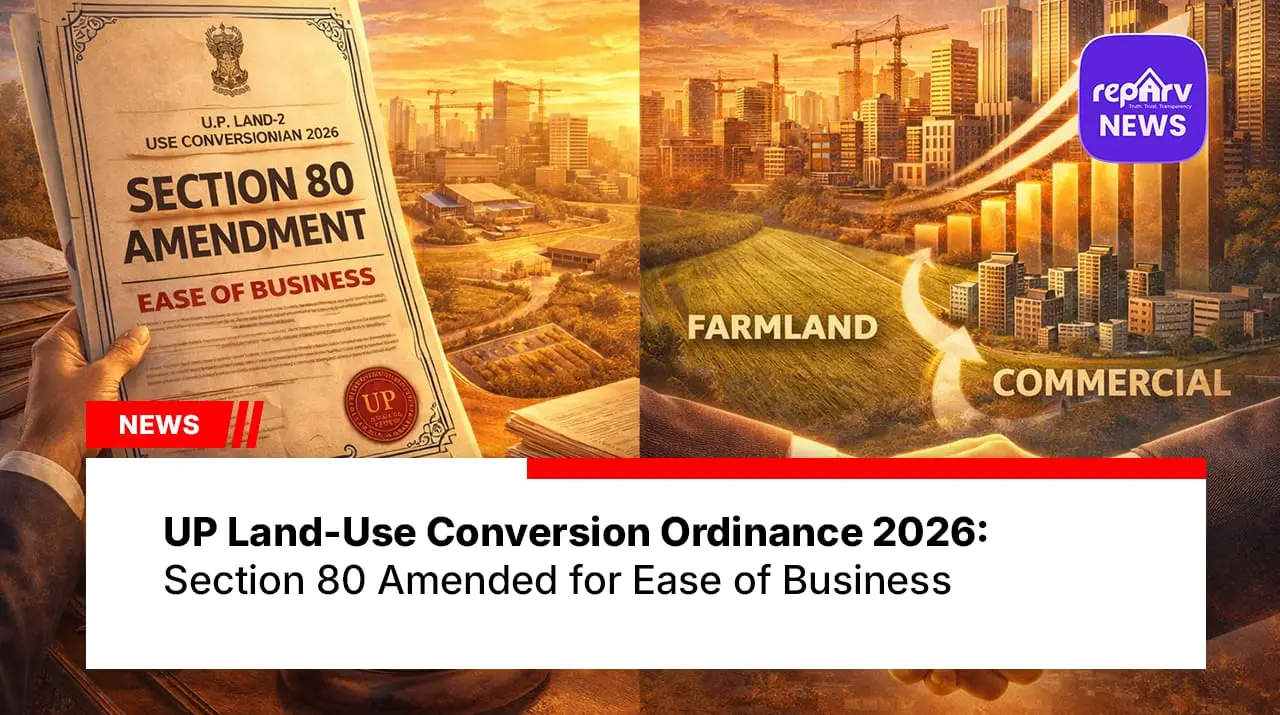
The Uttar Pradesh State Cabinet, led by Chief Minister Yogi Adityanath, has approved an important ordinance which will make land conversion easier across Uttar Pradesh. The state government created new regulations through its proposed amendments to the Uttar Pradesh Revenue Code 2006, including changes to Section 80 that end the dual approval requirement, which had been blocking state development projects.
Under the old system, the process of seeking a Section 80 declaration to convert land use from agricultural to non-agricultural had traditionally been a gruelling two-part process. The process begins with a request to the revenue department, which may be either the SDM or Tehsildar, seeking a Section 80 declaration for conversion of the land use. The applicant must complete the entire process before approaching the local development authority to request building plan approval. This two-part process has traditionally resulted in project delays of anywhere between six months and over a year.
State Finance Minister Suresh Kumar Khanna, while addressing the press after the cabinet meeting on Monday, the 23rd of March, 2026, confirmed the aforementioned. As far as areas falling within the jurisdictions of the Industrial Development Authorities, Uttar Pradesh Housing and Development Board (UPAVP), and other notified regulated areas, the requirement to apply for a land use change will no longer be necessary. Instead, the moment the building map is approved by the competent authority, the land use change will also be deemed to have been approved.
This measure has also been strategically implemented to accelerate the rate of development within the state of UP. The idea is to ensure that the raw acreage is converted into an operational site almost instantly, the moment the project plan is approved. As far as the real estate within the state of UP, particularly within areas such as Noida, Greater Noida, Lucknow, and Gorakhpur, is concerned, red tape will be significantly reduced. The administration believes that such an approach will not only bring relief to the individuals owning plots within the aforementioned areas but will also encourage greater investment within the state.
Meanwhile, the cabinet has given the green light to the Safe Reuse of Treated Water Policy, 2026. This is also in line with the state’s push for the circular economy. In the face of increasing pressure on water resources due to the effects of urbanisation, the policy envisions the phased implementation of water reuse for non-potable purposes. In the first phase of implementation, the policy aims to cover the urban local bodies for horticulture, construction works, and irrigation. In the second phase, the policy envisions the reuse of water for the industrial and agricultural sectors. In the third and final phase, the policy envisions the implementation of the dual pipe system in homes to segregate drinking water and water for secondary purposes like flushing.
The timing of these reforms is deliberate. In the state’s bid to aggressively push forward with the vision of becoming a $1 trillion economy, the government is identifying and removing “unnecessary clearances” for low-risk activities. In this way, by empowering Development Authorities to deal with what has traditionally been a multi-departmental revenue issue, the state is moving towards a new paradigm of self-certification and risk-based approval. For the Indian real estate market, this ordinance serves as a blueprint for how state governments can utilise statutory master plans to bypass traditional revenue roadblocks.
While this ordinance is a massive step forward, legal experts opine that for this to succeed, digital integration between the Revenue Department's records and the Development Authorities' planning portals will be essential. However, for now, the message from the Lucknow cabinet is clear: the era of chasing individual land conversion certificates is coming to a close, and the era of unified project clearance is upon us.





.webp)
.webp)
.webp)

.webp)

.webp)
.webp)
.webp)
.webp)













.webp)
.webp)


.webp)

.webp)
.webp)
.webp)
.webp)
.webp)
.webp)
.webp)



























.jpeg)