

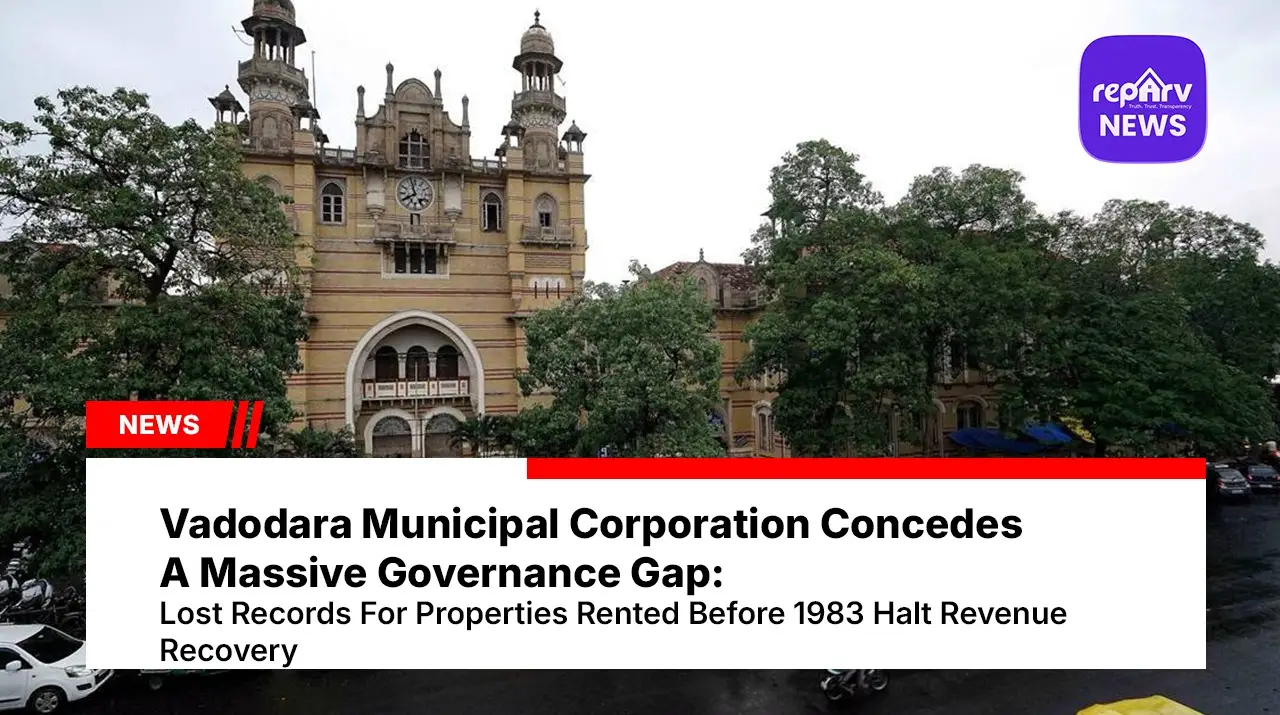
In a shocking revelation that has brought to light a massive administrative gap within the Vadodara Municipal Corporation (VMC), the civic body has admitted that it has no official records or original allotment letters for thousands of properties it rented out before 1983. This lack of record-keeping has brought the entire civic body to a grinding halt, resulting in a legal and financial mess involving a staggering amount of over ₹12 crore in pending rent recovery and unauthorised occupation of municipal land.
This shocking revelation came to light during a recent meeting of the VMC Standing Committee, where Chairman Dr. Sheetal Mistry confirmed that while the civic body does maintain a "rent register" for tracking incoming revenues, the original allotment letters, lease agreements, and other legal documents are simply non-existent in the municipal records for any property that was occupied before 1983. This documentation deficiency affects a large part of the city’s commercial sector, involving a total of 2,737 rental spaces, ranging from fixed commercial spaces to commercial cabins, handcart slots, and temporary shed spaces.
The Financial Fallout: A ₹12 Crore Revenue Deficit
The complete lack of VMC property documentation has created a situation that devastated the financial resources of the city. The VMC Estate Department is currently facing difficulties in recovering ₹12 crore in outstanding rent payments, which long-term tenants have refused to pay due to these existing administrative problems. The corporation lacks the required legal clout to pursue the defaulters or even serve them an official notice or eviction notice, as there is no original documentation of the lease agreement to rely on. Without the signed agreements, many tenants have been disputing the original terms, which has led to protracted litigation, further burdening the city’s finances.
Moreover, the absence of documentation has also hindered the VMC from adopting any effective rent revision policy. Today, many prime commercial properties in the best areas of Vadodara are leased out at nominal rates, which are decades old and have no relation to the current market value. This has led to a loss of potential revenue, which could have been used for the development of essential infrastructure in Vadodara or other welfare activities.
The Subletting Scandal and Unauthorised Transfers
The most negative impact of the missing files is the uncontrolled and illegal secondary market that has been created. The original beneficiaries of the VMC rental properties have either moved away or died over the last forty years, resulting in third parties obtaining control over the rental properties. The investigation revealed that these properties were leased out through illegal channels, enabling the tenants to charge excessive amounts while the VMC received no payment for the transfer transactions. In some cases, the current holders have no connection with the VMC but are still operating their businesses on municipal land in the name of the original allottees of the 1980s.
To reassert control over these "lost" assets and rectify its balance sheet, the Vadodara Municipal Corporation has adopted a contentious regularisation policy. Under this policy, the VMC is offering to formally transfer occupancy to the current resident in return for a fixed regularisation charge of ₹25,000. While the administration sees this as a sensible approach to regularise illegal occupancy and begin collecting updated rent, some city council members have expressed disapproval over this policy. Claiming that the flat rate is too lenient on residents who have been taking advantage of illegal subleasing for years.
Administrative Crackdown and Digital Reform
The discovery of "missing" VMC files from 1983 has triggered calls between Maharashtra and Gujarat for more transparent financial operations in the revenue departments. The current administration has committed to "reconstructing" these lost files through cross-referencing existing rent registers with site visits and resident testimony.
Dr. Mistry has also pointed out that in the case of properties where the resident differs from the original record, the VMC will not accept the previous nominal rates. Instead, the corporation will impose market-linked rental rates, thus transforming these idle assets into high-yielding assets. This move is part of the overall fiscal cleanup, which includes a 100% interest waiver on property taxes to wipe out the city's massive debt and promote civic cooperation among the merchant class.
The Path Toward a "Smart City" Vadodara
Urban planners believe that this particular event is a wake-up call for all city administrations in India. The VMC crisis in asset management underscores the need for GIS mapping and the complete digitalisation of all land records. Thus, a digital replica of the VMC’s rental stock could enable the VMC to automate rent payments, detect illicit transfers in real time, and ensure that all public lands are used for their designated purpose.
As the city moves ahead in its journey to become a Smart City, the legacy of the undocumented past continues to pose a challenge. The successful recovery of ₹12 crore in rent arrears and regularisation of close to 3,000 units will be the ultimate test of the VMC Estate Department’s efficiency. For now, the emphasis is on bridging the gap between the archives of 1983 and the reality of 2026, ensuring that the "Gateway to Gujarat" can finally account for every square foot of its municipal land.






.webp)
.webp)
.webp)
.webp)

.webp)
.webp)
.webp)
.webp)





.webp)
.webp)

.webp)
.webp)
.webp)
.webp)
.webp)
.webp)
.webp)
.webp)


















.jpeg)