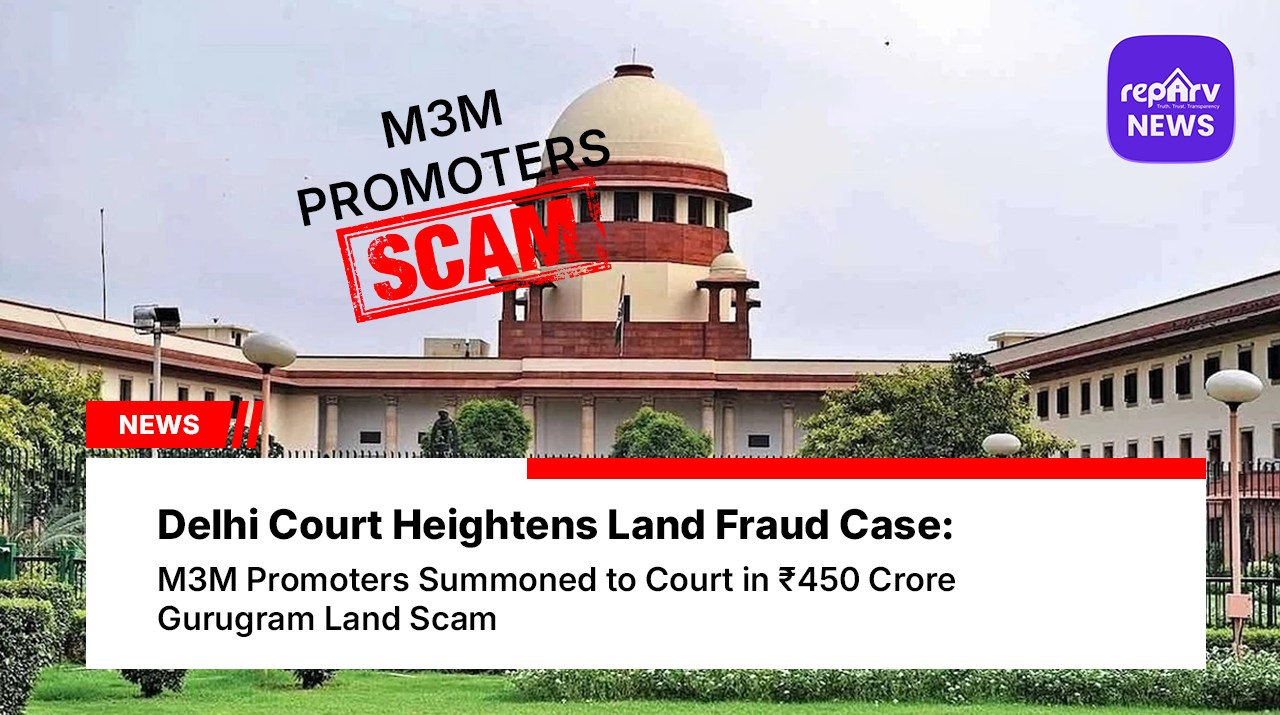



The Haryana Government’s Department of Town and Country Planning (DTCP) has invoked regulatory action against Golden Glow Estates, the holder of a license for a group housing scheme in Sector 68, Badshahpur, after its development license had lapsed in 2018, while government dues had risen above ₹51.8 crore.
The action is described as resulting from the expiry of "License No. 177 of 2008," originally issued in October 2008, for the development of a group housing colony over an area of approximately 10.68 acres in the Gurgaon-Manesar Urban Complex. According to official records, as revealed by recent reports, the license expired in October 2018, and its renewal was not effected within the prescribed period as contemplated under the Haryana Development and Regulation of Urban Areas Act, 1975.
The DTCP office has served the developer with a show-cause notice under Section 10 of the Act, requiring them to explain the reason for the continued default in compliance and to furnish reasons as to why action should not be initiated against them for violating the conditions of their license. The department has also mandated the District Town Planner (Enforcement) to serve the developer with a report within a certain time frame.
At the crux of the entire issue is the unpaid external development charges (EDC) and the resultant statutory dues. The unpaid amount, according to the departmental records, crossed ₹51.8 crore by December 2025. External development charges are mandatory fees that need to be paid by the developers of a real estate project and are used to create infrastructure such as roads, drainage, sewer connections, and other amenities required to support urbanisation. The non-payment of such dues not only amounts to a violation of license conditions but is also a planning concern in a growing urban center such as Gurgaon.
Other areas of non-compliance have been pointed out, and these are allegedly highlighted in the notice. These include failure to submit updated service plans, completion status reports, and other necessary documents that are due under the Urban Areas Rules, 1976. The bank guarantees provided to secure development commitments also reportedly expired in 2019 without renewal.
The project in question has been linked in the real estate sector to the Sky Ville project, which has faced hiccups over the course of its implementation. Though the DTCP notice is issued in the context of legal infractions related to the original license holder, this is part of the media spotlight on incomplete projects in Gurgaon, a city that has experienced significant development in this sector in the last two decades.
It has been indicated that if the developer does not explain the situation satisfactorily and settle the dues, the department can take action to cancel the licence, which can have serious consequences for the project’s future, whereby further development activities may be restricted for the project.
This comes at a juncture where the Haryana government has also been cracking down on defaulters in the real estate sector. In the past few months, there have been reiterations from the authorities on the point that if builders are not able to clear their dues related to E&D charges and others, they may not be able to obtain further licenses and approvals on new developments.
Gurgaon, later renamed Gurugram, remains one of the most prominent locations for acquiring both residential and commercial real estate, attracting investors from the NCR. However, owing to numerous experiences of delayed or abandoned residential schemes, the city has come under intense scrutiny.
For the entities or individuals that have been affiliated or have some connection to the Golden Glow Estates issue, the last regulatory action appears to pose even more questions. However, even though a show cause is not equivalent to a stop to construction activity, license cancellation might contravene the current governing law of the activity under consideration. According to experts proficient in jurisprudence relating to the Haryana Development & Regulation of Urban Areas Act, enforcement powers to comply with dues, making it payable as arrears of land revenue, and even reversion of land for non-compliance with stipulations exist under this statute.
The move of DTCP assumes that older projects, where the licenses are overdue, and the departmental dues are accumulating, will not let go easily. As the enforcement action progresses, all attention goes to the action taken by the developer, followed by the department.
This thus reminds one of the broader trend within the legislative regime in Haryana, whereby compliance with legislative obligations, including development charges and license renewal, remains a key consideration for sustainable development. While the outcome of the Golden Glow Estates case, which involves financial settlements, reinstatement, and cancellation of the license, will ultimately depend on the current proceedings, the message from the state’s planning authority appears to be bold.






.webp)
.webp)
.webp)


.webp)



.webp)
.webp)
.webp)
.webp)













.webp)
.webp)


.webp)

.webp)
.webp)
.webp)
.webp)
.webp)
.webp)
.webp)
































.jpeg)