


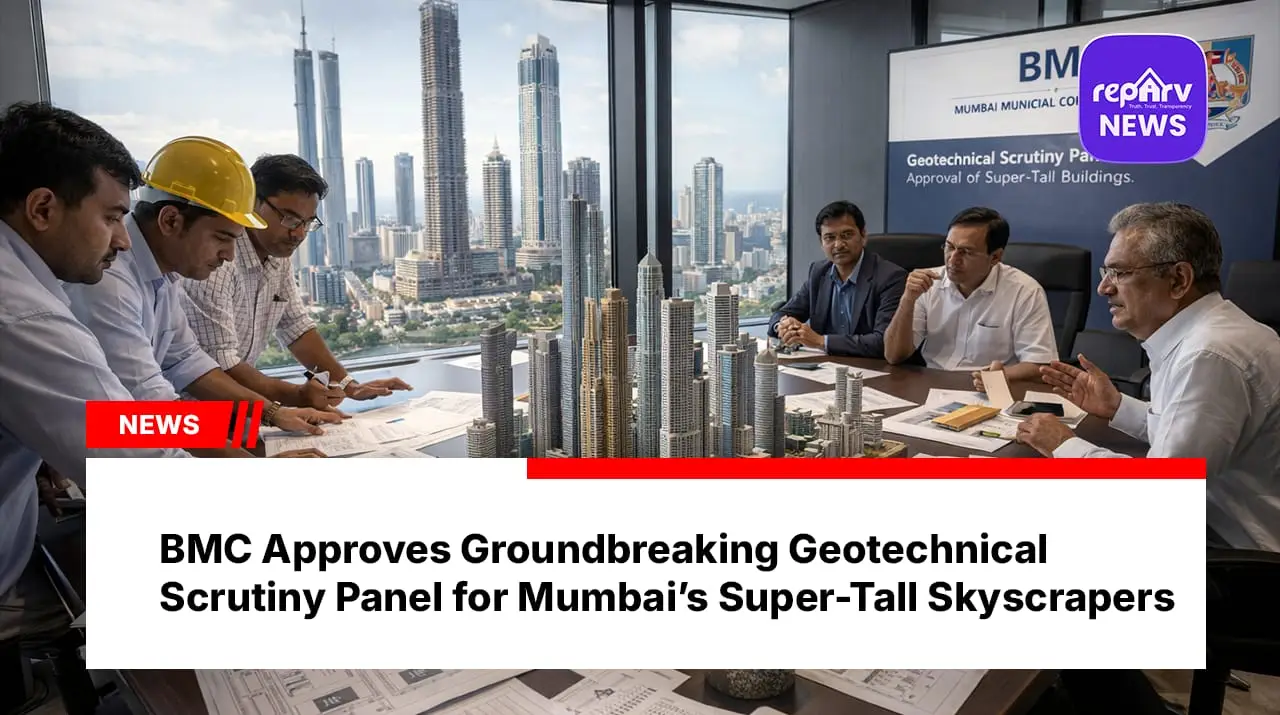
In a landmark move for the safety of the city’s infrastructure, the Brihanmumbai Municipal Corporation (BMC) has finally approved the empanelment of independent experts in geotechnical and foundation engineering to scrutinise the safety of the city’s towering skyscrapers. This landmark shift in the regulatory framework was approved by the BMC on Monday, the 9th of March 2026. This makes the BMC the first local authority in Asia to mandate the empanelment of experts in geotechnical engineering for the safety of the city’s super-tall skyscrapers.
This move assumes significance at a time when Mumbai’s real estate sector is witnessing a surge in skyscrapers touching the heights of 200 and 300 meters. This has led the BMC to introduce a mandatory geotechnical oversight to address growing safety issues related to deep excavation work in the densely populated city.
The 180-Meter Mandate: A New Frontier in Building Regulations
Under the newly implemented guidelines, all buildings over 180 meters in height (approximately 60 stories) must now be mandatorily cleared by the High Rise Committee (HRC). This is a critical threshold for super-tall buildings in Mumbai, as it ensures buildings of unprecedented scale are reviewed by more than just the internal team of developers.
Additionally, the BMC has established a critical threshold for a slenderness ratio. Regardless of height, buildings with a height-to-width ratio over 9 must now undergo review at this higher level. The "skinny skyscraper" regulation is a response to structural issues in Mumbai caused by land sizes, where developers must build extremely thin buildings to maximise their Floor Space Index (FSI).
Why Mumbai is Implementing Independent Geotechnical Signatories
Typically, foundation and soil reports are approved by structural experts appointed by the developer themselves. However, BMC found that structural requirements for deep basement excavations and pile foundation construction had extended beyond structural engineering oversight. The BMC took this decision following several recent incidents of poor work quality in shoring and foundation construction in high-density areas like Worli and South Mumbai, where deep digging for multi-level basements posed a threat to the stability of heritage buildings and underground utilities.
The experts empanelled by BMC from prestigious institutions like IIT-Bombay and VJTI will be independent signatories for foundation designs. For the first time in Indian construction history, it seems like responsibility for the integrity of groundwork will be taken by someone other than the original contractor or developer themselves.
Critical Areas of Scrutiny: From Soil to Shoring
The scope of scrutiny by the expert panel is exhaustive and includes the "invisible" aspect of the building's construction. Their main duties include scrutinising and validating soil and rock investigation reports to ensure they are accurate depictions of the complex subterranean geomorphology found in Mumbai. They are also required to provide thorough scrutiny and validation of the shoring systems, which are the temporary systems erected during the excavation stage.
In many cases in Mumbai, especially in redevelopment projects, the construction site is located only a few meters away from existing older buildings. The scrutiny and validation provided by the expert panel are meant to ensure that the buildings in the surrounding area are not damaged. This level of risk mitigation in the construction of high-rise buildings is set to become the new benchmark in other metros such as Delhi and Hyderabad.
Deep Insight: The "Rock Integrity Gap" in Mumbai’s Coastal Strata
While general news reports are more focused on the administrative aspects of the BMC’s move, a deeper insight into the situation reveals a more pressing concern.
The Insight: Mumbai’s unique strata consist of multiple layers of basaltic rock, some of which are interspersed with "soft pockets" of weathered rock. As the height of the structures increases beyond 200 meters, the capacity of rock foundations becomes non-linear. While soil tests are usually performed to ascertain the capacity of the foundations, they do not take into account the massive localised pressure of a 60-story tower. The empanelled experts are seeking the "Rock Integrity Gap" where the transition of soil to solid rock becomes inconsistent. This prevents the slight tilting of structures, as was seen in several international "pencil towers" in cities such as New York.
Market Impact: Enhancing Investor Sentiment in Luxury Properties
While this regulation may create challenges for developers and stakeholders, it also enhances investor sentiment in luxury properties in Mumbai to a considerable degree. Investors in luxury properties such as "sky villas" are becoming increasingly aware of structural integrity; having their property foundation checked by an IIT-certified professional adds to the unique selling proposition for luxury property developers.
Additionally, this regulation also supports the changes made to the DCPR 2034, which aims to strike a balance between increased vertical growth and public safety. By simplifying the approval process for mid-rise buildings up to 120 meters in height and intensifying it for super-tall buildings above 180 meters, BMC is trying to create a tiered system that supports sustainable density in the city.
Future Outlook: A Blueprint for Asian Megacities
Being the first city in Asia to adopt independent geotechnical signatures at the municipal level, Mumbai has certainly set the stage for other global megacities in Asia, which are in dire need of such measures in the face of rapid vertical growth.
The empanelment process is expected to be completed by the end of this month, and the scrutiny of the projects under the 180-meter rule is set to commence in Q2 2026. This is certainly a proactive step as the city continues its rapid ascent into the clouds.






.webp)

.webp)
.webp)

.webp)




.webp)
.webp)
.webp)
.webp)
















.webp)
.webp)


.webp)

.webp)
.webp)
.webp)
.webp)
.webp)
.webp)
.webp)


































.jpeg)