

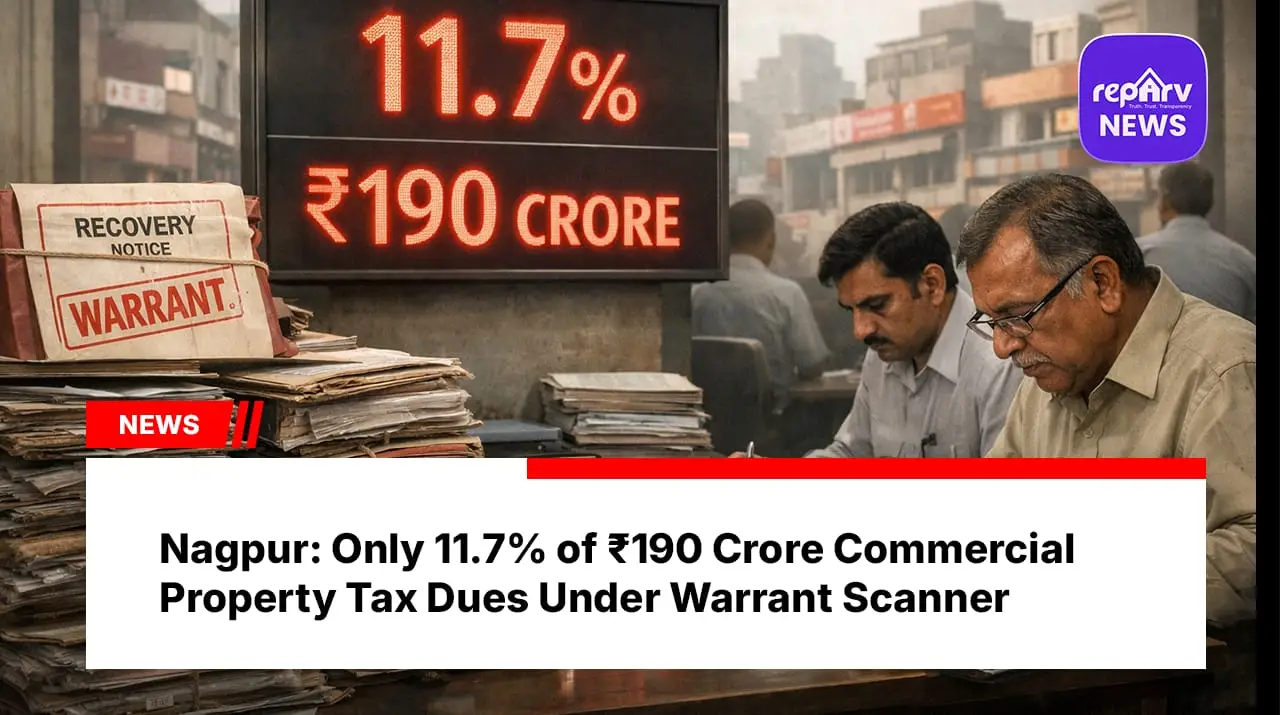
In a shocking revelation that has sparked significant concern regarding revenue recovery practices of local civic authorities, it has come to light that the Nagpur Municipal Corporation (NMC) has placed only a small fraction of its pending commercial property tax dues under warrant scanner, leaving a large part of the dues untouched despite financial pressures.
Available data reveals that only a meager 11.7% of the total ₹190.33 crore worth of commercial property tax dues pending has been placed under warrant scanner so far. Out of a total of 2,062 non-residential defaulters, warrants have been issued against only 359 properties, which is merely 17.4% of the total defaulters.
This has resulted in a huge gap between potential recoveries and actual recoveries, as a large part of approximately ₹167.98 crore, which is more than 88% of total dues, remains out of the scope of coercive recovery measures, highlighting inefficiencies in the system.
The analysis shows that most unpaid debts are concentrated among high-value defaulters who make up only a small portion of the total debt population. Around 229 commercial establishments that owe more than ₹5 lakh each account for a staggering ₹157.01 crore in arrears. However, warrants have been issued in only 53 cases against high-value defaulters, covering only ₹16.70 crore.
Even in the case of mid-level defaulter properties, the picture is not entirely different. In the case of properties that owe between ₹1 lakh and ₹5 lakh, a total of 1833 properties owe a total of ₹33.32 crore in arrears. However, warrants have been issued in only 306 cases, amounting to a mere ₹5.65 crore.
A warrant is one of the most powerful tools in the hands of municipal bodies to ensure tax recovery from defaulters. It involves a wide range of measures, ranging from the attachment and seizure of movable assets to auctioning properties to recover arrears.
However, a look at the figures suggests that this powerful tool has been employed in a selective manner instead of a comprehensive one.
The matter assumes even greater importance if seen in the context of the financial health of Nagpur. Property tax is an important source of revenue for the NMC to fund essential infrastructure and developmental initiatives in the city. Lower recovery is not only an added financial burden but also impacts the timely execution of important initiatives in the city’s infrastructure, road development, and environmental protection.
The figures have also raised questions about the effectiveness of the overall system in enforcing the recovery. Experts have opined that it is important to maintain a high level of enforcement to maintain tax discipline in the system. When a large number of defaulters are outside the effective ambit of stringent action, it impacts the overall system’s ability to maintain tax discipline.
This comes at a time when urban local bodies in India are under pressure to become more financially sustainable. In a developing urban centre like Nagpur, which is in the midst of rapid real estate development, this becomes an even more important issue.
Insight: A Structural Weakness in Urban Revenue Systems
This case from Nagpur shows a structural issue that affects more than just this specific case. Municipal corporations are increasingly adopting technology-based systems while creating more advanced rules and operational methods. However, execution does not necessarily keep pace with this trend, especially in dealing with large defaulters.
From a real estate and governance standpoint, this represents a two-fold risk. It slows down infrastructure development in a developing urban center like Nagpur, which is in the midst of rapid growth and development. It also represents a market imbalance, where compliant parties are forced to subsidize those that are not making timely payments.
From the perspective of the investor and stakeholders in the real estate industry, this trend highlights the need for stakeholders to focus more attention on the financial health of the city. Cities with stronger tax enforcement programs represent stronger infrastructure growth and asset appreciation potential in the long term. Unless the NMC increases its warrant action and takes a more aggressive approach to recovery, especially for high-value defaulters, the gap between dues and recoveries is expected to widen and impact the growth potential of the city.






.webp)

.webp)
.webp)


.webp)



.webp)
.webp)
.webp)
.webp)














.webp)
.webp)


.webp)

.webp)
.webp)
.webp)
.webp)
.webp)
.webp)
.webp)


























.jpeg)