

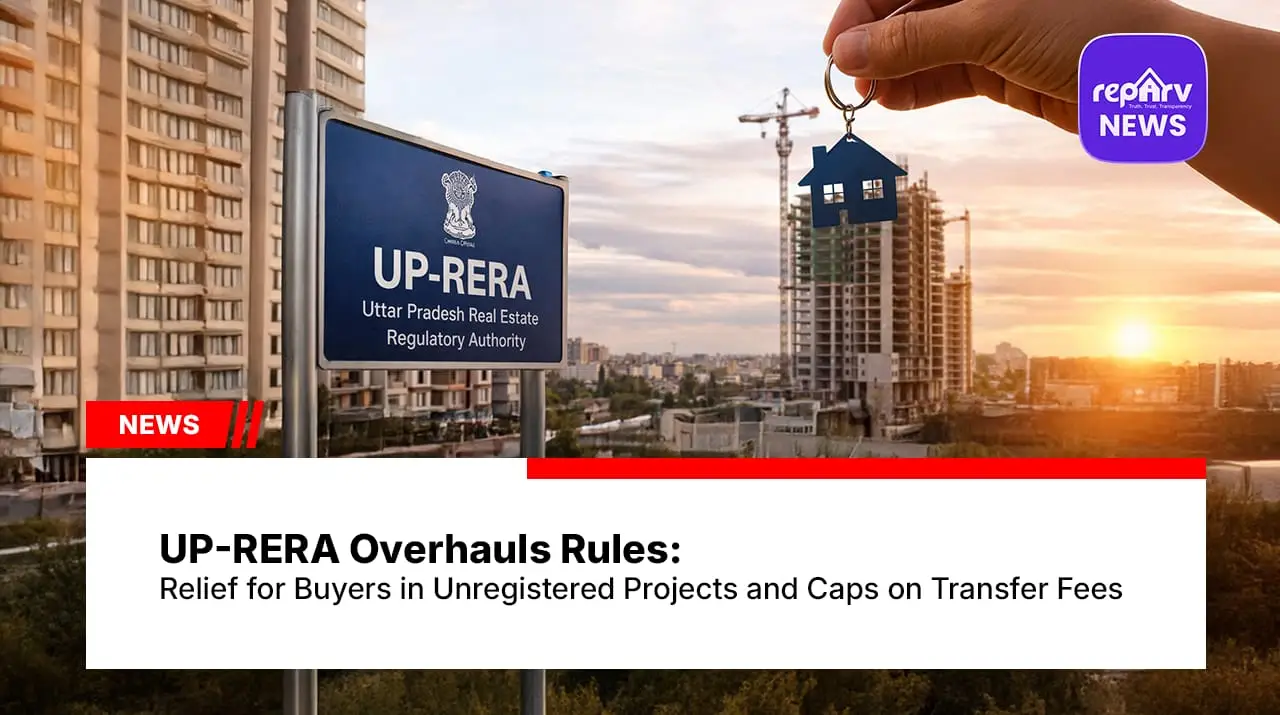
The Uttar Pradesh Real Estate Regulatory Authority (UP-RERA) has announced its 10th amendment to the General Regulations of 2019 as a major initiative to protect consumers operating in the real estate market. The new regulations, which came into effect on March 25, 2026, address two of the major grievances of consumers in the real estate market. The grievances include the absence of legal redressal for consumers who have invested in unregistered projects and the imposition of “transfer fees” by builders during property resale.
Legal Gateway for Unregistered Project Allottees
The most crucial change is to Regulation 24, which has been extended to include the authority’s power to hear the grievances from allottees of unregistered projects. Earlier, jurisdictional ambiguity in the regulations left consumers of unregistered projects without a legal platform to seek redress.
Under the new framework, the UP-RERA bench shall adopt a two-tier procedure. The bench will evaluate whether the project met all registration requirements at the time of its commencement. If the project is found to violate the registration norms, the authority shall initiate punitive action against the promoter while continuing to hear the buyer's complaint on its merits.
To facilitate this, the authority shall introduce a new form called 'Form M,' which shall be available on the UP-RERA portal. In the case of unregistered projects, there is usually a lack of centralised data. In such cases, the buyer shall have to disclose additional information to assist the authority in issuing notices. The existing regulations contain a major gap that builders use to avoid registration, and this amendment aims to eliminate that gap.
Standardisation and Capping of Transfer Charges
The amendment to Regulation 47 will provide financial relief by limiting all administrative and processing fees that developers charge during the transfer or inheritance of an allotment. In the past, developers have treated transfer and inheritance as a means of generating additional revenue from allottees.
The regulations are clear on the difference between familial transfers and third-party transfers. In the event of the allottee's death, transfer charges payable by family members for the allotment transfer are limited to a total of ₹1,000. However, the claimant must submit standard documents such as a death certificate, a succession certificate, and No-Objection Certificates (NOCs) from other legal heirs. In the case of a transfer to a non-family member or assignee, the maximum fee has been capped at ₹25,000.
Furthermore, the procedure for such a transfer has been simplified under the amendment. Developers are no longer allowed to require the execution of a new sale or lease agreement, which may involve unnecessary stamp duty and other costs. Instead, the transfer will be completed through an endorsement on the original agreement and updating the promoter’s records.
A Step Toward Market Transparency
UP-RERA Chairman Sanjay Bhoosreddy announced that these amendments are a step towards making the grievance redressal mechanism more transparent and effective for the consumers. The authority aims to enhance investor trust and develop the local real estate sector by regulating unregistered projects and standardising exit expenses in Noida, Greater Noida, and Lucknow.
Industry experts believe these developments will significantly improve the liquidity of properties in the resale segment of the real estate market, as transfer costs are clearly defined. Moreover, these developments ensure that buyers’ interests and capital investment are protected, regardless of the administrative status of the projects.






.webp)
.webp)
.webp)
.webp)

.webp)
.webp)
.webp)
.webp)










.webp)
.webp)
.webp)
.webp)
.webp)
.webp)
.webp)
.webp)
.webp)
.webp)






















.jpeg)